


The 2026 Radiology Coding Revolution: Are You Ready for the Big Shift?
December 16, 2025 | by Steven Johnson

Stop Leaking Revenue: The 2026 Radiology CPT® Overhaul is Here
The 2026 CPT® update marks the most significant overhaul of Radiology and Interventional Services in over a decade. With 418 total changes, including 46 brand-new codes for leg revascularization and the official arrival of Category I AI billing, “business as usual” is a strategy for revenue loss. This guide breaks down the seismic shifts in bundling, complexity-based reporting, and digital health that every practice must master by January 1st.
The 2026 CPT updates for Radiology and Interventional Services are not just minor administrative shifts; they represent an industry-wide overhaul. With 418 total changes, 2026 is officially the year of “bundling” and “digital transformation,” bringing an end to the “old way” of reporting. If your practice isn’t actively adjusting its documentation templates now, you are likely to face significant revenue leakage and compliance risks starting January 1st.
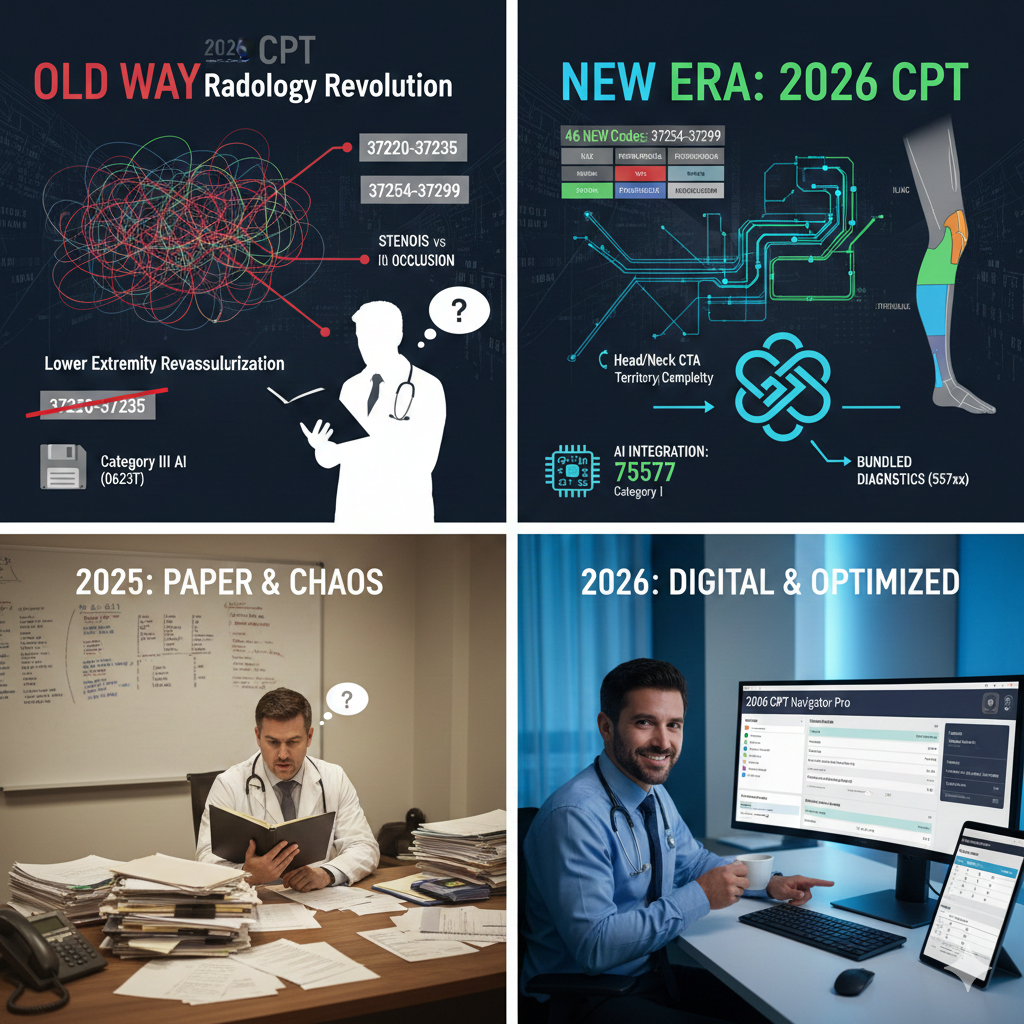
The most seismic shift is the complete dismantling of the lower extremity revascularization code family. The existing 37220–37235 codes have been deleted and replaced with a matrix of 46 new territory-based codes (37254-37299). This new structure includes a dedicated inframalleolar region for arteries below the ankle, alongside the traditional iliac, femoral/popliteal, and tibial/peroneal territories.
Crucially, these codes now differentiate between “straightforward” stenosis and “complex“ occlusions. This means physicians must explicitly document whether a vessel has some blood flow or is 100% blocked to capture the true value of the work. Furthermore, the femoral and popliteal territory is now divided into two separate billable vessels: the common femoral/profunda and the superficial femoral/popliteal, allowing for more precise reporting of multi-vessel interventions.
Diagnostic imaging is seeing a parallel push toward efficiency through the bundling of frequently co-reported services. The new CPT 70471 now combines CTA of the head and neck into a single “super-bundle,” including all image post-processing. Similarly, CT cerebral perfusion has transitioned into two permanent Category I codes: 70472 (add-on for use with concurrent head studies) and 70473 (standalone), providing a stable reimbursement pathway for acute stroke imaging.
Perhaps the most historic milestone is the formal arrival of Artificial Intelligence in Category I billing. New code 75577 replaces previous temporary codes for the quantification and characterization of coronary atherosclerotic plaque using AI-driven software. This shift signals that AI is no longer “experimental” but a mainstream clinical tool. However, clinicians must now record how the algorithmic analysis influenced their final diagnosis to justify the reimbursement.
Beyond vascular and digital realms, 2026 introduces major refinements in urology and radiation oncology. The prostate biopsy section has been entirely restructured (55707–55714), with the new codes now bundling all imaging guidance—whether ultrasound, CT, or MRI fusion—directly into the procedure. In radiation oncology, traditional delivery codes have been retired in favor of a three-level system that folds all image guidance into the delivery charge itself.
Beyond vascular and digital realms, 2026 introduces major refinements in urology and radiation oncology. The prostate biopsy section has been entirely restructured. (55707–55714), with the new codes now bundling all imaging guidance—whether ultrasound, CT, or MRI fusion—directly into the procedure. In radiation oncology, traditional delivery codes have been retired in favor of a three-level system that folds all image guidance into the delivery charge itself.
RELATED POSTS
View all


What’s New in Physical Medicine and Rehabilitation Coding for 2026
January 9, 2026 | by Sarah Anderson


Everything You Need to Know About Modifier 25 in 2026
January 4, 2026 | by Sarah Anderson